

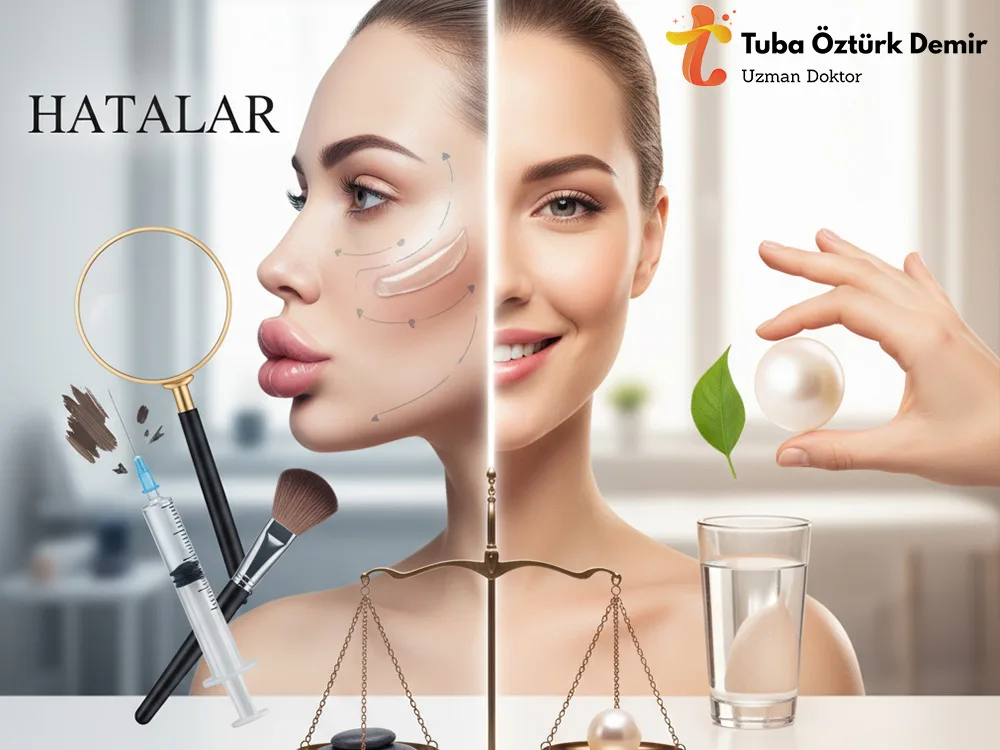
Ten common misconceptions about medical aesthetics, from “more is better” to choosing on price alone, and a more realistic way to look at each.
Medical aesthetics has grown considerably in recent years in terms of both visibility and accessibility. Social media filters, “before and after” images, short videos and shared experiences are making many people more curious about this field. However, at a time when information is so easy to reach, incorrect or incomplete information can unfortunately spread just as quickly. This can pave the way for both unrealistic expectations and poor decisions.
In this article, I would like to look in general terms, and without making definite promises, at the medical aesthetics mistakes we often encounter and at some common misconceptions. The aim is to help people who are thinking of starting a medical aesthetics journey gain a more informed, calmer and more realistic perspective.
Myth 1: “The More Procedures, the Younger You Look”
One of the most common mistakes in medical aesthetics is the idea that having many procedures at the same time will give better and faster results. Yet when the face and body become the target of too many interventions at once, the outcome may not always be as expected.
An approach closer to the truth looks like this: a planned, gradual and personalized approach can often pave the way for more controlled, more natural and more manageable results. Although there are situations in which more than one procedure needs to be performed on the same day, the best course for each patient is to proceed step by step once their general health, expectations and a face/body analysis have been assessed, and to plan this process together with the physician.
Myth 2: “Everyone Is Having the Same Procedure, So It Must Be Right for Me Too”
A sentence often heard on social media or among friends and family: “My friend had it done and is very happy; I want the same.” Yet one of the most important rules in medical aesthetics is that every face, every skin structure and every body is different.
A procedure that suits one person very well may not look equally natural and harmonious on someone else. Skin type, age, the strength of facial expressions, facial proportions, bone structure and even character play a role in this planning. For this reason, copying a treatment that worked well for someone else and applying it to everyone in exactly the same way is not the right approach. The physician’s role is not so much to make the patient resemble a reference photo as to create a plan that supports the patient’s own natural features.
Myth 3: “A Single Procedure Solves Everything”
One of the most frequently heard expectations goes something like this: “With a single procedure, I want my skin to glow, my wrinkles to fade, my dark spots to lighten and to look younger as well.” Medical aesthetics may aim to ease certain concerns, support some areas and improve appearance, but expecting a “magic wand” effect in one go may not be realistic.
In reality, every procedure has a target area and a limit. While some treatments focus on supporting volume loss, others are aimed at supporting skin quality and radiance, and others at softening the appearance of expression lines. Most of the time, the healthiest approach is to plan lifestyle changes, skincare and, where necessary, medical aesthetic treatments together, spread over time.
Myth 4: “The More Filler, the Younger and More Beautiful”
Dermal fillers are frequently chosen to support facial volume and soften the appearance of certain lines. But sometimes we come across this mistake: “A little more, a little more, just a little more…” Over time, the lips, cheekbones or jawline losing their harmony with the person’s facial proportions can lead to an artificial appearance.
The more balanced approach here is to proceed with “less is more” touches that are in harmony with the face. When dermal fillers are seen not as a way to turn the face into someone else’s but as a tool to support the volume that diminishes with age and to soften a tired expression, more natural results can be aimed for. Too much filler can, especially in the long term, reach a point where a person struggles to recognize their own face, which can cause psychological discomfort.
Myth 5: “Botulinum Toxin (Botox) Freezes the Face and Everyone Can Tell”
One of the most widespread preconceptions about botulinum toxin (Botox) treatments is that the face will be left completely motionless and the expression will freeze. In fact, this is mostly related to the wrong dose, the wrong choice of area or planning that does not suit the person’s pattern of facial expressions.
A statement closer to the truth is this: botulinum toxin treatments carried out in controlled doses, taking into account facial anatomy, the strength of facial expressions and the person’s expectations, may aim not to eliminate expressions altogether but to soften the depth of wrinkles. The goal is not a “frozen” facial expression; it is to help create the impression of a more rested and calmer look. For this reason, open communication with the physician is of great importance in botulinum toxin treatments in terms of dose and area planning.
Myth 6: “Every Procedure Is Suitable for Everyone; Anyone Who Wants It Can Have It”
Because medical aesthetic procedures appear so often on social media, they can sometimes be perceived as “ordinary cosmetic treatments.” Yet, like any medical procedure, treatments such as dermal fillers, botulinum toxin, mesotherapy, IV therapy, ozone and glutathione should be planned with medical history, medications in use, chronic conditions, allergies and general health in mind.
In situations such as pregnancy, breastfeeding, the use of blood thinners, certain autoimmune diseases or the presence of advanced chronic conditions, some procedures may be postponed or not performed at all. For this reason, one of the most important steps is to share your medical history in detail with the physician before the procedure. The “it’s done for everyone, so it will be fine for me too” attitude is not a sound perspective from a medical point of view.
Myth 7: “I’ll Stay at Home and Within a Week No One Will Notice”
Some people may think that after a medical aesthetic procedure everything will return completely to normal within the same day. Of course, after many treatments a person can return to daily life in a short time; however, temporary side effects such as redness, swelling and bruising are also possible, and this is entirely normal.
The right expectation should be this: the recovery process after any procedure can vary from person to person. While for some people this process is much quicker and more comfortable, others may have mild signs lasting a few days. Following the physician’s recommendations for the periods before and after the procedure can help recovery go more smoothly.
Myth 8: “The Lower the Price, the Better the Deal”
When it comes to medical aesthetics, thinking only in terms of price is also a common mistake. Very low prices can raise questions about the quality of the product used, its authenticity, the clinic’s facilities and the practitioner’s experience. Of course, a high price does not always mean the best; but choosing something only because it is cheap can also be risky.
What matters here is transparent information, the reliability of the products used, the physician’s experience and the clinic’s hygiene conditions. In a medical procedure, asking “Where is the safest and most appropriate place for me?” rather than “Where is the cheapest?” is generally a sounder approach.
Myth 9: “An Aesthetic Procedure Is All I Need; I Can Leave Everything Else the Same”
Expecting miracles from medical aesthetic procedures alone while factors such as fatigue, dull skin, low energy, a stressful life, lack of sleep and an unbalanced diet continue is another common mistake. Medical aesthetics most often finds a healthier place as a component that supports lifestyle changes.
Our body can function in a healthier way together with many factors such as good-quality sleep, a balanced diet, adequate water intake, cutting down on smoking and alcohol, light exercise and stress management. When medical aesthetic treatments are added on top of this foundation, they can become a tool that supports the process. In other words, the “let me leave everything the same and just have something done to my face” approach may not provide the desired satisfaction in the long run.
Myth 10: “It’s Enough to Look at the Result, Not the Doctor”
Sometimes people try to decide by looking only at “before and after photos.” Yet one of the most important elements in medical aesthetics is what the physician performing the procedure brings: medical knowledge, a perspective on facial aesthetics, an ethical stance and the way they communicate with the patient.
Photos can give an idea of the result, but they do not always reflect the whole truth. Moreover, the result on another face may not have the same effect on yours. For this reason, when choosing a physician, open communication, a thorough examination, time being made for your questions and honest information about the risks are criteria just as important as the result itself.
Conclusion: More Informed Steps, a Calmer Medical Aesthetics Journey
When planned correctly, medical aesthetics is a powerful tool that can help a person feel better and see a more rested and balanced reflection when they look in the mirror. However, it should be remembered that this field is not a fast-consumed trend but a health-based discipline.
To avoid common mistakes and misconceptions, it is important to set out with realistic expectations, not to take filtered images on social media as a reference, not to compare yourself with others, to communicate openly and honestly with your physician and to put your health first at every step.
If you are thinking of taking a step into medical aesthetics, the first thing to do is to meet face to face with a physician you trust and share your medical condition, expectations and concerns in detail. In this way, you lay the groundwork for mapping out together the most appropriate, most natural and safest route for you.
The information on this page is for general information only and does not replace diagnosis or treatment. Results may vary from person to person. The approach suitable for you is determined after a medical examination.